Mar
15

GAO: WMATA failed to adequately prepare for SafeTrack maintenance plan

3/15/2017    

Rail News: Passenger Rail

Continue reading

Copyright

© © TradePress Media Group, Inc.

Mar
15

FRA posts status update on PTC implementation

3/15/2017    

Rail News: PTC

Continue reading

Copyright

© © TradePress Media Group, Inc.

Mar
15

Project update: A longer subway in Los Angeles

Rail News Home Passenger Rail March 2017 Rail News: Passenger Rail

— By This email address is being protected from spambots. You need JavaScript enabled to view it., Senior Associate EditorWhen it's finished in nearly eight years, the Los Angeles County Metropolitan Transportation Authority's (Metro) Purple Line subway extension will be a heavy-rail line between the Wilshire Boulevard Western Station and the VA Hospital Station in West Los Angeles. Ultimately, the project — also known as the Westside Purple Line Extension — involves the construction of 9 miles of track and seven stations.The long-awaited project will connect West Los Angeles to Metro's expanding rail network, which agency officials believe will improve transportation for residents and visitors in a city that is known as one of the most traffic-congested communities in the United States.The project is being built in three phases. Phase I — which is under construction — will extend the subway from the terminus at Wilshire/Western 3 miles to Wilshire/La Cienega and will feature three underground stations: Wilshire/La Brea Avenue, Wilshire/Fairfax Avenue and Wilshire/La Cienega Boulevard.One of the agency's priority projects, the extension’s first phase is funded by Measure R funds, federal "New Starts" matching funds and a low-interest Transportation Infrastructure Finance and Innovation Act loan from the U.S. Department of Transportation.The first phase's engineering and construction work is managed by Skanska, Traylor Brothers Inc. and J.F. Shea Construction Joint Venture (STS), which was awarded the $1.6 billion design-build contract in 2014. Contract procurements were completed in September 2015.Phase I construction is expected to conclude in June 2023, with testing, pre-revenue and revenue service slated for early November 2023.Project to hit milestones this yearSTS expects to complete right-of-way work in late March and final design work in early April, according to Metro spokesman Dave Sotero.Three advance utility relocation contracts have been completed and construction on two of the three underground stations is underway, said Gary Yeo, Metro’s project controls supervisor-program control, in an email.At the Wilshire/La Brea Station site, crews are constructing supports for the excavation under the deck. At the Fairfax station, temporary street decking has begun. Also, ground treatment for the tunnel cross passages are ongoing, said Yeo.In terms of Phase I’s engineering, design and construction work, the design-build team is employing an integrated project team model, said Sotero in an email. The model allows the team to use the best resources from Metro and the engineering and construction management consultants, he said.A few unique circumstancesThe project also involves the use of "Revit modeling," in which all engineering disciplines are designed in one model during the advanced preliminary engineering phase, said Sotero. STS is completing final design using this same model, he added."This approach is unique in the rail-transit industry and has resulted in producing a high-quality final design in a very short time frame," said Sotero. “The use of the model in planning construction is also anticipated."From an engineering and design perspective, the extension project has involved unusual ground conditions because it's being built in the La Brea Tar Pits area.For example, excavation work in November 2016 near the location of the future Wilshire/La Brea station turned up parts of ancient mammoth fossils, including a partial skull and tusks."Because of the asphaltic conditions, a paleontological monitoring zone has been identified, where the contractor will need to excavate in thin layers — six inches each layer — and more carefully so that fossil resources can be identified and recovered," said Sotero.Due to those conditions, Metro built an exploratory shaft to further study ground conditions and fossil recovery methods, and allow prospective contractors to review materials first hand, he added."Thanks to all that preparation work, a meticulous preliminary study of ground conditions and some additional geotechnical investigation work performed at the very beginning of the project, our team did not face any completely unexpected challenges," Sotero said.Phase II contractor lined upMeanwhile, the $1.37 billion design/build contract for the extension's second phase was awarded Jan. 26 to Tutor Perini/O&G.Phase II work calls for extending the line another 2.6 miles and adding stations at Wilshire/Rodeo in downtown Beverly Hills and in Century City. The budget for the second phase has been set at $2.4 billion.Phase III involves extending the line to the Westwood/VA Hospital. Construction is expected to begin as early as 2019, according to Metro’s “The Source” blog.Metro has committed to completing the entire subway extension by 2024, a summer Olympics year. Los Angeles leaders hope the International Olympics Committee will choose the city to host the games — and if that happens, the new subway would be helpful in transporting visitors between venues, Metro officials say.Earlier this month, Budapest withdrew its bid from consideration, leaving only Los Angeles and Paris as host-city candidates.Email comments or questions to This email address is being protected from spambots. You need JavaScript enabled to view it..
Keywords Browse articles on Los Angeles County Metropolitan Transportation Authority Purple Line Extension Skanska Traylor Brothers Inc. and J.F. Shea Construction Joint Venture STS Tutor Perini/O&G TIFIA Parsons Transportation Group L.K. Comstock Contact Progressive Railroading editorial staff.

Copyright

© © TradePress Media Group, Inc.

Mar
14

Dittmann, Hincke appointed to Canada's transportation safety panel

3/14/2017    

Rail News: People

Continue reading

Copyright

© © TradePress Media Group, Inc.

Mar
14

North Carolina DOT offers transit passes to Amtrak riders

3/14/2017    

Rail News: Passenger Rail

Continue reading

Copyright

© © TradePress Media Group, Inc.

Mar
14

Sound Transit names Honeywell chief HR officer, surpasses diversity goals

3/14/2017    

Rail News: People

Continue reading

Copyright

© © TradePress Media Group, Inc.

Mar
14

NTSB investigating ethanol train derailment in Iowa

3/14/2017    

Rail News: Federal Legislation & Regulation

Continue reading

Copyright

© © TradePress Media Group, Inc.

Mar
14

MARTA approves new TOD partnership at King Memorial rail station

3/14/2017    

Rail News: Passenger Rail

Continue reading

Copyright

© © TradePress Media Group, Inc.

Mar
14

APTA makes case for including transit in Trump's infrastructure plan

3/14/2017    

Rail News: Federal Legislation & Regulation

Continue reading

Copyright

© © TradePress Media Group, Inc.

Mar
14

Project update: CSX's Virginia Avenue Tunnel

Rail News Home CSX Transportation March 2017 Rail News: CSX Transportation

The two new Virginia Avenue tunnels will converge at the new structure’s west end. A 300-foot portion of the old tunnel was demolished to accommodate work on the first new tunnel.Photo – CSX By This email address is being protected from spambots. You need JavaScript enabled to view it., Managing EditorCSX’s multiyear effort to eliminate a major rail chokepoint and modernize aging infrastructure in Washington, D.C., has just passed the halfway point. That milestone moves the Virginia Avenue Tunnel reconstruction project a bit closer to an anticipated mid-2018 completion.The $250 million, 42-month project calls for replacing a 3,800-foot, single-track tunnel built beneath Virginia Avenue in southeast Washington more than a century ago with two larger one-track tunnels to accommodate double-stack trains. Work began in May 2015 and the first of two planned phases was completed in late 2016.Originally constructed in 1872 by the Baltimore and Potomac Railroad, the tunnel was rebuilt in 1906. The 18.7-foot-tall tunnel needs to be replaced because it’s near the end of its useful life, has cracked masonry and a deteriorating drainage system, and regularly floods during heavy rains. Plus, its single track causes extensive congestion for both freight and commuter trains.The new 4,100-foot-long, 21-foot-tall tunnels will improve the fluidity of freight and passenger trains on one of the region’s busiest rail lines; lessen the impact of freight trains on passenger-rail service by providing two-way traffic; ease highway congestion; and reduce the risk of rail service disruptions caused by flooding and other severe weather, according to CSX.The commonwealth of Virginia provided $24 million for the project, with remaining costs to be covered by the Class I. Virginia officials opted to contribute funds because state ports could gain improved freight-rail access to interior markets and truck traffic could be reduced on interstates 81 and 95, says CSX spokesman Rob Doolittle.In addition, eliminating the single-track bottleneck will help both Virginia Railway Express and Amtrak, which approach the District’s Union Station from the south on the same mainlines that extend through the tunnel, he says. The project’s first phase — a newly built southern tunnel with track — was completed in December 2016, a month ahead of schedule. CSX moved the first double-stack train through the structure two days before Christmas.A critical ‘Gateway’ componentThe entire tunnel will cap off 61 clearance projects that needed to be completed for CSX’s National Gateway, a double-stack corridor the Class I has been developing the past several years between Mid-Atlantic ports and the Midwest via an $850 million public-private partnership. The gateway provides the railroad a more efficient and environmentally friendly route for moving double-stack trains, says Chuck Gullakson, CSX’s assistant vice president-National Gateway and chief project engineer for the Virginia Avenue Tunnel reconstruction.For example, the first train that moved through the new higher southern tunnel was able to carry more containers between Portsmouth, Va., and CSX’s large intermodal terminal in North Baltimore, Ohio.“This tunnel was critical for us,” says Gullakson.Now, finishing the second phase is crucial to fully garnering the reconstructed tunnel’s benefits. Construction and engineering work for the entire project is being managed by joint venture (JV) partners Clark Construction Group LLC and Parsons Transportation Group through a design-build contract.The second phase involves demolishing the remaining sections of the existing tunnel’s roof and south wall and constructing a new 4,100-foot, cut-and-cover north tunnel; building an additional track; backfilling the trench; removing temporary bridges; and permanently relocating numerous water, sewer, electric, communications and gas utilities. Cut and cover is a construction method for shallow tunnels in which a trench is excavated and roofed over with a sturdy overhead support system.During the project’s first phase, the JV team demolished about 300 feet of the tunnel’s south wall and roof to accommodate the new south track; built the 4,100-foot, cut-and-cover south tunnel in a trench up to 50 feet deep adjacent to the existing tunnel; and completed six temporary roadway bridges to maintain ongoing north-south vehicular and pedestrian traffic.
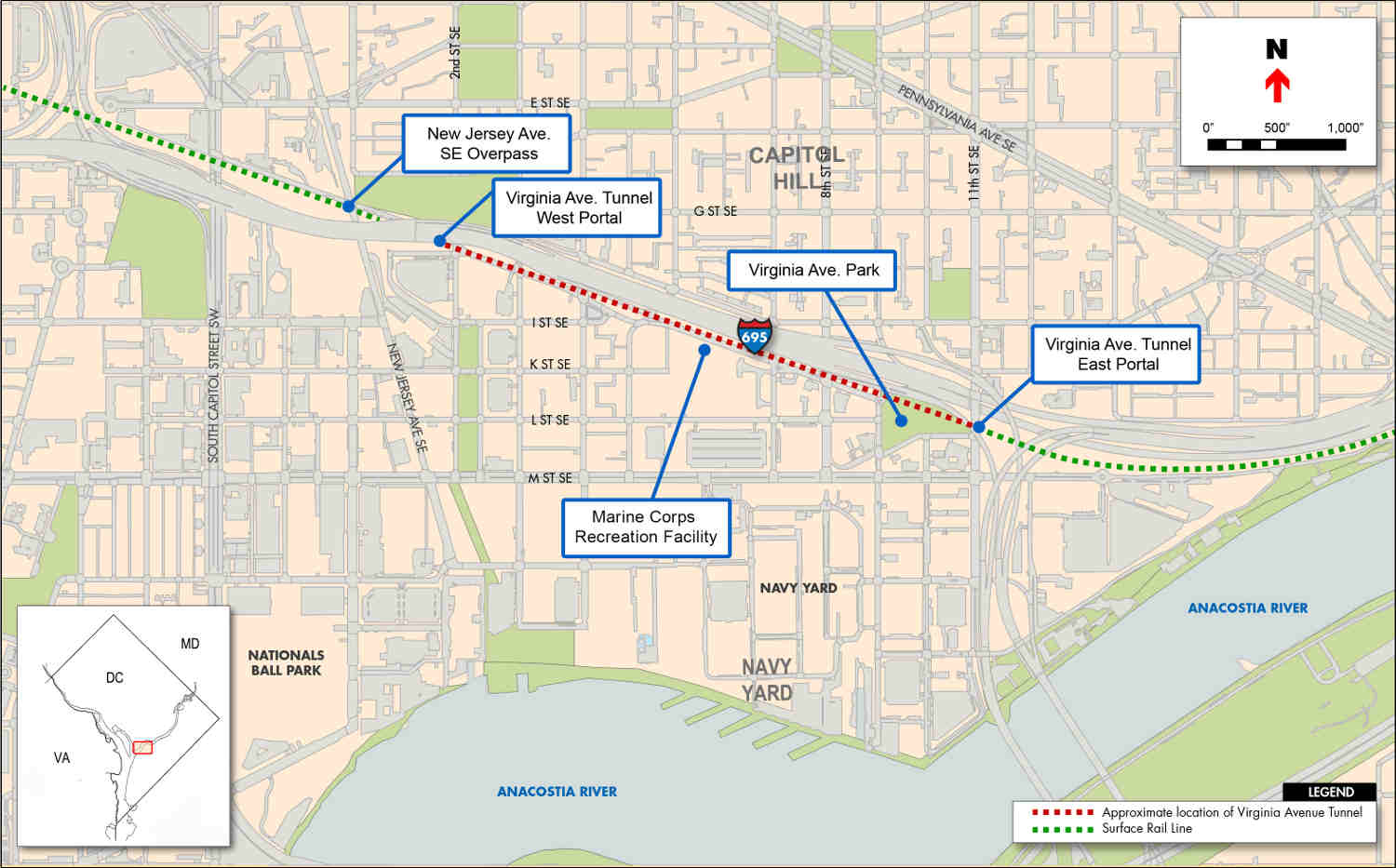
The Virginia Avenue Tunnel covers a 10-block, heavily populated area in southeastern Washington, D.C.
(Click to view larger.) Source – CSXWhen the project’s completed in summer 2018, there will be a single two-track portal at the west end — the two tunnels will merge into one for about 300 feet due to the existing configuration of highway-bridge piers and other existing infrastructure. At the east end, the two tunnels will follow different paths to accommodate the 11th Street bridge highway piers.The tunnels will split into two structures about 1,000 feet west of the portals. Over the remaining 2,800 feet, the two separate tunnels will share a common center wall, which will be built with steel-and-concrete pilings drilled 40 to 50 feet into the ground.Underground movementThe biggest construction challenge thus far: coordinating and clearing the relocation of many utilities in a 200-year-old, densely urban environment that includes seven busy streets and hundreds of residents in a 10 city-block area, says Gullakson.Utility relocations during the first phase involved two complex interfaces with sanitary sewers and the lowering of a combined sewer by 11 feet, says Phil Sheridan, a senior vice president for Clark Construction subsidiary Clark Civil LLC. Excavation work uncovered a surprise, as well — portions of the original tunnel that were abated, but never removed from the site, when a realignment was completed in the early 1900s, he says.Utility work in the second phase will be less onerous, involving six instead of 23 relocations, says Sheridan. “But we will need to build larger temporary road bridges,” he says.The JV team also will need to continue performing work without interrupting CSX’s operations. About 20 freight trains travel through the tunnel daily, plus there are train operations adjacent to it. So, crews must perform tasks in between trains, says Sheridan. The first tunnel was built parallel to the old tunnel so trains weren’t disrupted.Phase two likely will conclude two-and-a-half months ahead of schedule, says Sheridan. As of last month — the 21st month in the 42-month schedule — major tunnel demolition work was slated to start at February’s end and concrete work in the second tunnel was pegged to begin in April.A lot of material already has been moved and many tasks have been accomplished during the project’s first half. As of Jan. 1, 20,900 truckloads of dirt had been excavated, 50,000 cubic yards of concrete had been poured and 1,913 of a required 2,250 pilings had been drilled.After the tunnels are finished, the JV team will need to complete restoration and other related work. CSX agreed to provide the following post-project neighborhood enhancements: improvements to Garfield Park; enhancements to Virginia Avenue Park, including a new dog park; a straightened alignment of Virginia Avenue SE; improved street lighting; and new green space and landscaping, with additional trees, brick sidewalks and granite curbs.Need to be a good neighborThe Class I has tried to mind residents’ concerns during construction, says Gullakson. The railroad has monitored air, noise and vibrations, logging a total of 11,312 hours for those activities as of Jan. 1. In addition, the JV team has employed a closed-trench method during tunnel construction to improve safety, implemented measures to control dust and tried to limit work hours. Pilings are being drilled instead of driven to reduce vibration, says Gullakson.In addition, since the project’s initial stages, a community office has been open to deal with local issues and the railroad has been in constant contact with residents via emails, text messages, phone calls and alerts hung on front doors, he says. As of Jan. 1, CSX had logged nearly 79,000 such contacts with locals.“We want to be the best neighbor for the community,” says Gullakson. “We try to be proactive.”CSX also has tried to employ a take-charge approach to ensuring there’s enough capacity to meet its traffic-growth goals. The new double-stack-height Virginia Avenue Tunnel should play a key role in accommodating higher intermodal flows along the National Gateway come mid-2018 and beyond, Gullakson believes.“The tunnel will be built according to our traffic needs,” he says.Email questions or comments to This email address is being protected from spambots. You need JavaScript enabled to view it.Work Performed by Major Subcontractors for Virginia Avenue Tunnel Project:•Cast-in-place tunnel and retaining walls/Tiber Creek bridge/precast erection — Clark Civil LLC, a Clark Construction Group LLC subsidiary, Bethesda, Md.•Tunnel concrete — Clark Concrete, a Clark Construction Group subsidiary, Bethesda, Md.•Excavation support — Clark Foundations, a Clark Construction Group subsidiary, Bethesda, Md.•Excavation/backfill — Metro Earthworks LLC, a division of Shirley Contracting Co. LLC, Lorton, Va.•Tunnel electricity and security — C3M Power Systems, a Clark Construction Group subsidiary, Bethesda, Md.•Roadway reconstruction — Metro Paving Corp., Hyattsville, Md.•Reinforcing installation — Wings Enterprises Inc., Washington, D.C.•Trackwork and track drainage — Delta Railroad Construction Inc., Ashtabula, Ohio•Waterproofing — AndieMac Waterproofing & Restoration, Fulton, Md.Source: CSX and JV Partners
Keywords

Browse articles on CSX Virginia Avenue Tunnel Clark Construction Group LLC Parsons Transportation Group Clark Civil LLC National Gateway intermodal railroad contracting

Contact Progressive Railroading editorial staff.

Copyright

© © TradePress Media Group, Inc.

Mar
13

Valley Metro honored for Northwest light-rail extension project

3/13/2017    

Rail News: Passenger Rail

Continue reading

Copyright

© © TradePress Media Group, Inc.

Mar
13

BART incentive program helps alleviate morning traffic congestion

3/13/2017    

Rail News: Passenger Rail

Continue reading

Copyright

© © TradePress Media Group, Inc.

Mar
13

Washington state panel OKs funds for safety improvements at oil-train crossing

3/13/2017    

Rail News: Safety

Continue reading

Copyright

© © TradePress Media Group, Inc.

Mar
13

Caltrain's Hartnett lobbies in D.C. for electrification project

3/13/2017    

Rail News: Passenger Rail

Continue reading

Copyright

© © TradePress Media Group, Inc.

Mar
13

South Carolina authority kicks off Inland Port Dillon project

3/13/2017    

Rail News: Intermodal

Continue reading

Copyright

© © TradePress Media Group, Inc.

Mar
13

Florida's Brightline passenger-rail service to launch in late July

3/13/2017    

Rail News: Passenger Rail

Continue reading

Copyright

© © TradePress Media Group, Inc.

Mar
13

At Alaska Railroad, workforce cuts reflect traffic decline

Rail News Home Short Lines & Regionals March 2017 Rail News: Short Lines & Regionals

Last month, Alaska Railroad Corp. eliminated 49 jobs — the regional's fourth round of layoffs since 2008.Photo – Alaska Railroad Corp. By This email address is being protected from spambots. You need JavaScript enabled to view it., Managing EditorA railroad certainly wouldn't choose to chart its annual volume totals over a nine-year period with lines going down and to the right. But that's what the Alaska Railroad Corp.'s (ARRC) freight tonnage chart looks like for the years 2008 through 2016.Annual volume has plummeted 44 percent in that timeframe, from 6.6 million tons in 2008 to 3.7 million tons in 2016. The primary causes: bulk petroleum traffic that's fallen from 1.9 million to 300,000 tons over the nine years, and export coal volume that's plunged from 1.2 million tons in 2011 to 67,000 in 2016.Low oil prices and the 2014 closure and 2016 scrapping of a North Pole refinery — which at one time generated half of ARRC's annual revenue — have cut crude/petroleum business by 84 percent.At the same time, an oversupply of coal in world markets caused Alaska's only mine to curtail production, significantly shrinking the railroad's export coal moves from Healy to the Port of Seward and prompting ARRC to temporarily close its coal export facility in Seward."We've really been suffering the last few years. About two-thirds to three-quarters of our revenue comes from the freight side," says ARRC President and Chief Executive Officer Bill O'Leary, adding that the railroad also generates revenue from passenger-rail services and real estate holdings.At what cost?The regional's finances have reflected that pain. Net income has tumbled from $12.5 million in 2008 to $4.5 million in 2016. In addition, ARRC has recorded a net loss from operations since 2015 and forecasts a $4.9 million loss in the 2017 budget, and has incurred higher operating costs associated with labor and benefits, positive train control implementation and other business demands.As a result, ARRC last month announced it eliminated 49 positions under a corporate restructuring plan. The reorganization represents an 8 percent reduction in the regional's year-round workforce — which totals 609 versus the seasonal workforce of 760 — equating to an estimated labor cost savings of $4.7 million.ARRC began to address the job cuts last year, leaving 18 of the 49 positions vacant. ARRC has eliminated more than 300 year-round jobs since 2008, a period that includes three other layoffs."The eliminated positions weren't our first choice. But it became evident that we had to go back to adjusting our staffing levels," says O'Leary.To shed costs, ARRC also reduced train operations between Fairbanks and Anchorage from two trains, seven days per week to one train, five days per week. In addition, the railroad plans to divest some assets that support export coal business, says O'Leary.Ridership growth a reliefDespite its freight-traffic woes, ARRC has grown passenger counts 22 percent since 2010. Ridership — which last year rose 4 percent from 2015's mark to 494,236 — is increasing both because of local demand and tourism, says O'Leary."Visitors see Alaska as an exotic but safe location," he says. "The cruise industry has brought more ships to Alaska."The railroad is projecting 5 percent ridership growth in 2017. As for freight traffic, it might at least stabilize this year, says O'Leary."We're optimistic that it will level out from where it was in 2016," he says.
Keywords Browse articles on Alaska Railroad short line passenger rail ARRC Bill O'Leary Contact Progressive Railroading editorial staff.

Copyright

© © TradePress Media Group, Inc.

Mar
13

GE aims to close the gender gap to be viewed as a high-tech job destination for all

Rail News Home People March 2017 Rail News: People

Millie Dresselhaus, the late professor emeritus of physics at the Massachusetts Institute of Technology, was recently featured in a GE commercial promoting women in science. Dresselhaus died last month at 86.Photo – GE By This email address is being protected from spambots. You need JavaScript enabled to view it., senior associate editorLast month, GE announced a goal to employ 20,000 women in science, technology, engineering and mathematics (STEM) roles — with 50-50 male-female representation in all of its entry-level technical programs — by 2020.The company set the goal to "inject urgency" into ending the gender imbalance in technical fields. That imbalance must be addressed to "fully transform GE into a digital industrial company," GE officials say. "We believe a company that changes the world should reflect the world — that's why we set this aggressive goal," says Athena Kaviris, senior human resources leader at GE Transportation. "Just hiring talented women isn’t enough. We have to recruit the best, retain them and spread the word to make sure people really view GE as a destination for high-tech jobs." The initiative will apply to all the company's divisions including GE Transportation, which serves the rail industry.Along with its announcement, GE released a white paper titled "Engineering the Future: The Socio-Economic Case for Gender Equality," which highlights the lower rate of women serving in technology and engineering and makes the economic case for closing the gender gap.Women account for 47 percent of total U.S. employment, but only 14 percent of all engineers and 25 percent of IT professionals. That gender gap is preventing the technology and engineering sectors from contributing as much as possible to the U.S. economy, according to the report's authors, GE Chief Economist Marco Annunziata and GE Global Economist Kimberly Chase.The stakes of filling high-tech jobs will become greater as technology evolves, affecting more jobs that require advanced skills, Annunziata and Chase wrote. Over the next decade, the U.S. alone will need to fill about 2 million engineering and computing jobs, they said."As new technologies require new abilities, the risk of the skills gap widening will only become greater," the authors wrote. "We need to close the gender gap and leverage our entire talent pool."Over the years, GE has implemented a number of strategies to draw more women into high-tech jobs, says Kaviris. Today, 18 percent to 20 percent of jobs in GE’s overall professional workforce fall under the STEM categories. And, GE employs about 15,000 women in its technical entry-level positions.While the company has made progress, more needs to be done to recruit and retain more female engineers and IT employees. GE intends to meet its new goal in part by building on established career-development efforts such as its Edison Engineering Development Program (EEDP), an intensive early-career plan for engineers. EEDP already has achieved a 50-50 gender ratio among its participants, "and that is one area where we feel great about the progress," says Kaviris. Female employees also are being encouraged to tap into GE's Women's Network, a career advancement effort that builds leadership skills. Additionally, the company is expanding "GE Girls," a program designed to encourage school-age girls to explore STEM education and careers. Launched in 2011, GE Girls has hosted events for female high-schoolers at nine U.S. universities. Last year, GE Girls launched the "GE Girls Club" to encourage participants to stay connected to STEM education during their high-school years."But, we obviously can do more," says Kaviris. "The technical and engineering sectors are still very male dominated, and the pipeline for future talent is probably not transitioning as fast as we need it to. That’s all the more reason for us to spread the STEM message."Another way GE hopes to achieve its goal: make sure employee recruitment activities include colleges and universities that enroll a higher percentage of female students."We've had a great tradition of building relationships through existing alumni and penetrating those schools in a positive way," says Kaviris. "As we examine those programs further, it's important to make sure they're representative of the 50-50 percentage we're looking for."Besides publishing the white paper, GE has promoted its gender-parity goal and spread the STEM word via television commercials that ask, "What if female scientists were treated like celebrities?" One commercial features the late Mllie Dresselhaus, a professor emeritus of physics at the Massachusetts Institute of Technology. Dresselhaus, who died last month, was known as the "queen of carbon" because of her research of carbon nanotubes.A goal that helps other companies, too
Although GE's goal is specific to its own workforce, its effort serves as a beacon to highlight the transportation industry’s need to recruit and retain more women into STEM and other jobs, according to the leader of WTS International, a U.S.-based global organization that promotes advancement of women in transportation."I think it is a huge benefit to have large corporations like GE get behind the goal of closing the gender gap in STEM," says WTS Chairwoman Diane Woodend Jones. "I applaud them for doing this."WTS has chapters worldwide — including 74 in the United States — that offer networking, professional development, education and mentoring for women who work in transportation or are studying to get there.Last year, women made up 10 percent of the rail-industry workforce and nearly 24 percent of the transportation and warehousing sectors, according to the U.S. Bureau of Labor Statistics. This year, WTS has set a new goal toward narrowing the gender gap by doubling the number of WTS chapters on college and university campuses to help connect female students with transportation employers. Currently, there are 14 WTS campus chapters.However, exposing young women to transportation career opportunities should really start when they're still in middle and high school, Jones says. To that end, WTS began working with the U.S. Department of Transportation several years ago to launch Transportation YOU, an interactive mentoring program that introduces girls ages 13-18 to jobs in the industry.WTS chapters offer Transportation YOU activities and events to encourage girls to take courses in math, science, and technology as a springboard to further study in STEM and transportation.Making gender equality a goal and promoting more women to leadership roles in business not only fills job openings, it benefits the bottom line, says Jones. "Many studies show that companies do better [economically] when they have more diversity in their workforce at all levels," she says. GE's white paper makes the same point. "Addressing the gender gap will create a more diverse workforce, and research shows that diverse teams are better at problem-solving and think more creatively," Annunziata and Chase wrote. "Unless they become more diverse, companies will not be able to cope with today’s more disruptive innovation environment."
Keywords Browse articles on GE STEM gender gap Athena Kaviris GE Transportation GE Women's Network GE Girls WTS International Diane Woodend Jones Transportation YOU Contact Progressive Railroading editorial staff.

Copyright

© © TradePress Media Group, Inc.

Mar
10

Rail supplier news from Trimble, Railhead, Kapsch, STV and Greenbrier (March 10)

3/10/2017    

Rail News: Supplier Spotlight

Continue reading

Copyright

© © TradePress Media Group, Inc.

Mar
10

WMATA taps Cherrington as inspector general

3/10/2017    

Rail News: People

Continue reading

Copyright

© © TradePress Media Group, Inc.